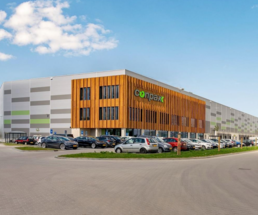
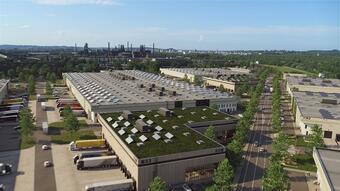
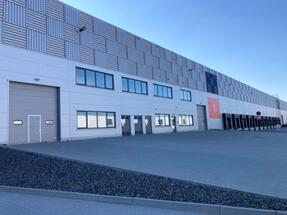
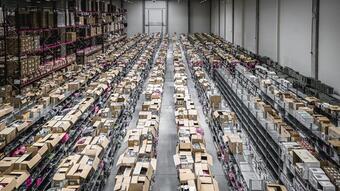
VGP NV (‘VGP’ or ‘the Group’), a European provider of high-quality logistics and semi-industrial real estate, has published its Corporate Responsibility Report 2021. The report details VGP’s achievements and progress against its previously set targets and underscores the company’s commitment to strengthening sustainability efforts across its day-to-day business. VGP’s key objective is to align its portfolios’ performance with the goals of the Paris Agreement and is working with clients to help them realize their decarbonization strategies — efforts that are intended to drive near-term actions that will help set the world on a path to achieving net-zero carbon emissions by 2050.
Despite a cursory glance at European data, it seems that the Czech Republic is the premier in the region of Central and Eastern Europe in the number of m2 of industrial real estate per person, the current situation in the lack of new warehouse and production space is critical in our country. Prices around Prague and Brno for rent are skyrocketing (up to 50% year on year) and new construction is in jeopardy. Delivery times for new turnkey industrial buildings are being extended due to Russian aggression in Ukraine, and what used to take 7 months to build is now being delivered in 9-12 months. Builders often do not hold quotations for more than a week, so companies have to make quick decisions and approves, which can be a problem, especially for multinational corporations. This was stated by Prochazka & Partners.
According to Savills latest report, 2021 was the best year on record for the Czech industrial market in terms of tenancy activity, despite the low volume of new completions and extremely low vacancy rate. Gross take-up totalled a staggering 2.32 million sqm, being 53% higher than the previous record of 1.55 million sqm seen in 2020. Annual net take-up (excl. renewals) reached 1.48 million sqm, a 46% increase over the former record of 1.01 million sqm registered in 2017, Savills reports.
A new logistics warehouse will be built in Valašské Meziříčí, which is being prepared by DB Schenker in cooperation with the Arete investment group. In two halls, they will find a place of service for the existing customer from the region, coffee producer Jacobs Douwe Egberts, as well as for new projects. The terminal will improve coffee supply chain management and expand DB Schenker's logistics network. The warehouse is scheduled to begin operating this September.
Demand for warehousing capacity is high, as is demand for logistics services. The combined transport terminal in the logistics zone in Mošnov will help solve this situation in northern Moravia. The first future tenant that has already been officially confirmed is PST CLC. In addition to transport and customs services, it will also offer clients warehousing in the form of logistics outsourcing.
Skladon, one of the largest Czech providers of fulfillment for e-shops, continues its mission to provide Czech e-shops with the simplest possible logistics with fast delivery worldwide. Last year, it increased its turnover by 157 percent to 121 million crowns and is already used by a total of 70 e-shops with a total turnover of several billion crowns. Last year, the company shipped goods to 182 countries around the world and helped its clients grow by an average of 156 percent year on year. In the next two years, Skladon plans to expand with new distribution centers abroad and at the same time expand its Ostrava premises by more than half of its current area.
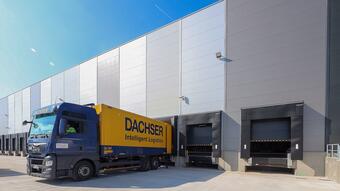
The European developer and owner of the semi-industrial and logistics real estate VGP has completed the construction of Hall C in VGP Park České Budějovice located in the Světlík commercial zone. The building was tailored to Dachser Czech Republic, an international logistics company specializing in collection services, contract logistics and other services. The ceremonial handover of the new logistics and office space with a total area of 7,042 square meters has already taken place. The operation of the logistics center will start in the coming days.
The builders of the warehouses and logistics complexes will not stop since the outbreak of the covid pandemic due to the demand driven by the boom of online stores. That is, if they have a place to build. And it is the lack of vacant land and the complex permitting process, in which the inhabitants of many municipalities are not in favor of building halls, that increasingly developers are moving towards projects mixing warehouses with smaller retail spaces, and in some cases even leisure areas.