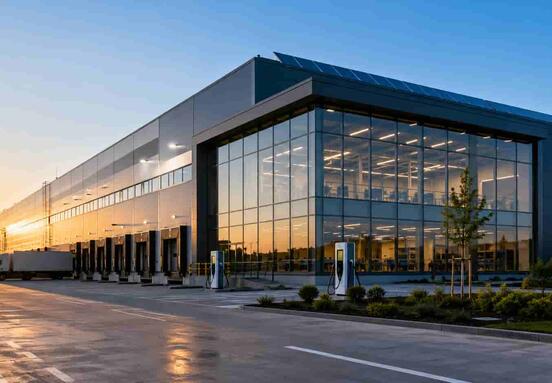
This shift, known as “in-house construction,” represents a fundamental departure from a model that has been established in the construction industry for decades.
The key question is whether this is a long-term transformation of development practices or simply a response to current market pressures.
???? Fewer bidders, increasing market pressure
This trend is already clearly visible in international markets. In Dubai, tenders that previously attracted up to 25 bidders now often receive only 2–3 participants. In the UK, 40% of developers report difficulties in securing sufficient competition in tender processes.
The result is reduced negotiating power for investors and increasing pressure on pricing, timelines, and contractor capacity.
In Central Europe, including the Czech Republic and Slovakia, the situation remains more stable, but similar patterns are emerging: fluctuating contractor capacity, rising costs, and decreasing predictability in delivery timelines.
????️ Industrial development under structural pressure
The logistics and industrial real estate sector is particularly sensitive to these changes. Projects are large-scale, complex, and highly dependent on the coordination of multiple subcontractors.
The traditional model separates responsibilities:
- contractors focus on delivering within time, budget, and scope
- developers focus on financial performance and long-term asset value
However, this separation often creates structural tension that is reflected in day-to-day site decisions.
⚠️ In-house construction: greater control, greater responsibility
By building internal execution teams, developers gain direct control over construction processes and faster access to on-site information. Issues can be identified earlier, and decision-making becomes more operational and immediate.
At the same time, responsibility shifts entirely to the developer, including:
- subcontractor coordination
- site logistics management
- health and safety oversight
- change and variation control
Without robust systems and processes, in-house teams risk facing the same inefficiencies as external contractors—without the ability to transfer accountability.
???? The key issue is not the model, but information flow
The main limitation of traditional construction models is not the organizational structure itself, but how information is transferred across the project.
When data from the construction site reaches decision-makers too late, it leads to delayed responses, cost overruns, and inefficiencies—regardless of whether the project is delivered internally or externally.
As a result, attention is increasingly shifting toward digitalization.
???? Digitalization as an alternative approach
Modern digital platforms connect all stakeholders in real time—from developers to subcontractors—within a single environment.
In practice, this enables:
- real-time construction reporting
- centralized project documentation
- structured tracking of changes and variations
- immediate visibility of budget and schedule impacts
A key feature is also 360° site documentation, which allows continuous visual tracking of construction progress and retrospective verification of project phases.
???? The future of industrial construction: control over information is decisive
In Central Europe, in-house construction is not yet a widely adopted standard. However, the pressure for greater transparency, more precise planning, and detailed documentation continues to grow.
Future competitiveness will therefore not depend solely on whether a developer builds in-house or through a general contractor, but rather on:
how effectively project information is managed throughout the entire lifecycle.
This is where digital tools are becoming a critical factor in improving efficiency and transparency in industrial development.